

Eating places and bars will shut early in Tokyo and a dozen different areas throughout Japan starting Friday because the nation widens COVID-19 restrictions because of the omicron variant, which has induced circumstances to surge to new highs in metropolitan areas.
The restraint, which is one thing of a pre-state of emergency, is the primary since September and is scheduled to final by Feb. 13. With three different prefectures — Okinawa, Hiroshima and Yamaguchi — underneath related measures since early January, the state of restraint now covers 16 areas, or one-third of the nation.
Whereas many Japanese adults are absolutely vaccinated towards COVID-19, few have gotten a booster shot, which has been an important safety from the extremely contagious omicron variant of the coronavirus.
COVID-19: JAPAN ASKS US MILITARY TO STAY ON BASE AMID PANDEMIC
The Health Ministry on Friday authorized Pfizer vaccinations for youngsters aged 5-11, who're more and more weak to an infection.
All through the pandemic, Japan has resisted using lockdowns to restrict the unfold of the virus and has centered on requiring eateries to shut early and never serve alcohol, and on urging the general public to put on masks and apply social distancing, as the federal government seeks to attenuate harm to the economic system.
Below the most recent measures, most eateries are requested to shut by 8 or 9 p.m., whereas massive occasions can enable full capability if they've anti-virus plans. In Tokyo, licensed eateries that cease serving alcohol can keep open till 9 p.m. whereas these serving alcohol should shut an hour earlier.
Eating places that shut at 9 p.m. and don’t serve alcohol obtain 30,000 yen ($263) per day in authorities compensation, whereas those who shut at 8 p.m. get 25,000 yen ($220) per day.
Critics say the measures, which nearly completely goal bars and eating places, make little sense and are unfair.
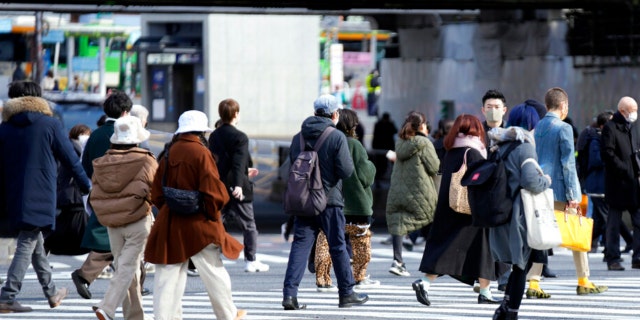
Individuals sporting protecting masks to assist curb the unfold of the coronavirus stroll alongside a pedestrian crossing Friday, Jan. 21, 2022, in Tokyo.
(AP Photograph/Eugene Hoshiko)
Mitsuru Saga, the supervisor of a Japanese-style "izakaya" restaurant in downtown Tokyo, stated he selected to serve alcohol and shut at 8 p.m. regardless of receiving much less compensation from the federal government.
"We cannot make business without serving alcohol," Saga stated in an interview with Nippon Tv. "It seems only eateries are targeted for restraints."
Some consultants query the effectiveness of inserting restraints solely on eateries, noting that infections present no indicators of slowing within the three prefectures which have already been subjected to the measures for almost two weeks.
After greater than two years of repeated restraints and social distancing requests, Japanese are more and more turning into much less cooperative to such measures. Persons are again to commuting on packed trains and buying at crowded shops.
Tokyo’s principal practice station of Shinagawa was packed as normal with commuters speeding to work Friday morning.
Japan briefly eased border controls in November however shortly reversed them to ban most international entrants when the omicron variant started spreading in different nations. Japan says it's going to persist with the stringent border coverage by the top of February because the nation tries to bolster medical programs and therapy.
CALIFORNIA BILL WOULD ALLOW PRETEENS TO BE VACCINATED WITHOUT PARENTS' CONSENT
The robust border controls have triggered criticism from international college students and students who say the measures usually are not scientific.
A bunch of students and Japan-U.S. consultants not too long ago launched a petition, led by Japan Society head Joshua Walker, calling on Prime Minister Fumio Kishida and his authorities to permit international students and college students to enter the nation once more underneath cautious preventive measures.
A letter to Kishida, signed by a whole lot of lecturers and consultants in Japan-U.S. research, urged his authorities to loosen up border controls to permit educators, college students and students to enter Japan and pursue their tutorial exercise. A lot of them have been pressured to surrender Japan research and focus as an alternative on different nations, together with South Korea.
"They become the bridges between Japan and other societies. They are future policymakers, business leaders, and teachers. They are the foundation of the U.S.-Japan alliance and other international relationships that support Japan’s core national interests," the letter stated. "The closure is harming Japan’s national interests and international relationships."
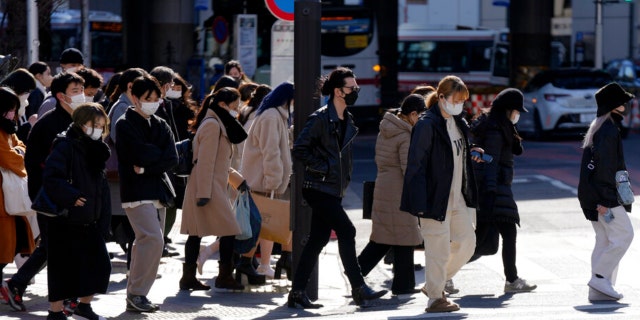
Individuals sporting protecting masks to assist curb the unfold of the coronavirus stroll alongside a pedestrian crossing Friday, Jan. 21, 2022, in Tokyo.
(AP Photograph/Eugene Hoshiko)
Japan not too long ago introduced it's going to enable 87 college students on Japanese authorities scholarships to enter the nation, however petitioners say there are a lot of others on international government-sponsored scholarships who nonetheless can't get in.
Tokyo logged 8,638 new circumstances of coronavirus an infection Thursday, exceeding the earlier file of seven,377 set the day earlier than.
At a Tokyo metropolitan authorities job drive assembly, consultants sounded the alarm on the fast-paced upsurge led by omicron.
Norio Ohmagari, Director of the Illness Management and Prevention Middle of Nationwide Middle for World Well being and an advisor to the Tokyo metropolitan authorities panel, stated Tokyo’s day by day new circumstances could exceed 18,000 inside per week if the rise continues on the present tempo.
Although solely a few of the hovering variety of contaminated persons are hospitalized and occupying lower than one-third of obtainable hospital beds within the Japanese capital, consultants say the speedy upsurge of the circumstances might shortly overwhelm the medical programs as soon as the infections additional unfold among the many aged inhabitants who usually tend to turn into significantly in poor health.
Surging infections have begun to paralyze hospitals, faculties and different sectors in some areas.
The ministry has trimmed the required self-isolation interval from 14 days to 10 for individuals who come into shut contact with somebody who exams constructive for COVID-19, and to seven days for important staff in the event that they check destructive.
Whereas about 80% of Japanese have obtained their first two vaccine doses, the rollout of booster pictures has been sluggish and has reached only one.4 % of the inhabitants thus far.
All Images and Video are Copyright to their Respected Owners


